

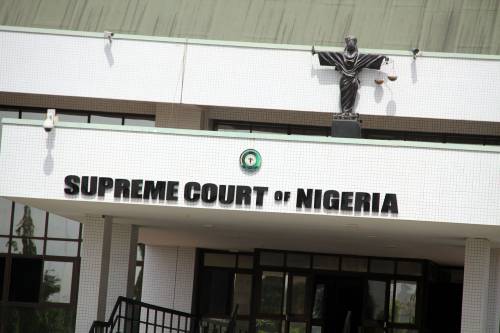

Ten months after the Supreme Court judgement on local government autonomy, the Federal and state governments are yet to implement the judgement, Citizen Rapporteur observes.
The Supreme Court had in a landmark judgement delivered on July 11, 2024 in the case of Attorney-General of the Federation v Attorney-General of Abia State & 35 Ors, granted full fiscal autonomy to local government councils in Nigeria.

The apex court ruled that in view of section 7(1) of the 1999 Constitution of the Federal Republic of Nigeria which recognises the local government system under a democratically elected leadership, it is thus unconstitutional to appoint caretaker committees to superintend over the affairs of local governments.
On the issue of withholding allocations and other funds accruing to the local government, the Supreme Court baldly reprimanded governors indulging in such illegality, saying such acts constitutes a sheer affront to the spirit and letters of the constitution.
However, up till this moment, the apex court’s judgement still remains nugatory as no local government council has received any allocation directly from the Federal Government.
Meanwhile, the ex-Accountant-General of the Federation, Mrs Oluwatoyin Madein, had, earlier in the year, requested local government councils to submit their respective account numbers in order to give effect to the Supreme Court judgement; but she later complained that the delay in the direct disbursement of funds was caused by the local government councils themselves, owing to the refusal of some councils to submit their account numbers.
Likewise, in a purported move to implement the judgement, the Central Bank of Nigeria (CBN) earlier asked each local government to provide two years of audited financial reports before opening accounts for direct allocation payment. However, the Association of Local Governments of Nigeria (ALGON) has expressed concerns that this requirement undermines the spirit of the Supreme Court’s decision.
It is therefore beffudles the mind to realise that after so many back-and-forth moves, the judgement is still, up till this moment, nugatory. This development stands in sharp contrast to the threats of Dr Musa Adamu Aliyu, the chairman of the Independent Corrupt Practices and Other Related Offences Commission (ICPC), to bring to book any stakeholder who defies the apex court’s order.
It is regrettable that while the status quo remains, the future of local government appears bleak as those concerned are showing no interest in making it work.
