

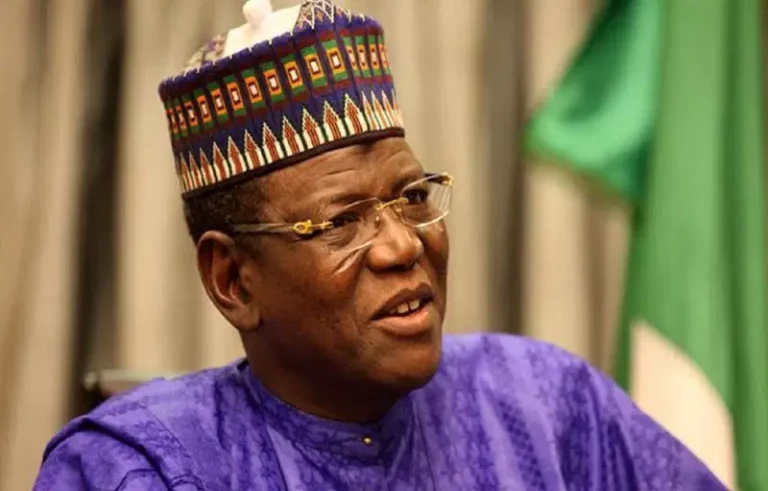

Former Jigawa State governor, Alhaji Sule Lamido, has revealed that he was the first person to confront the then Military President Ibrahim Badamasi Babangida and tell him to his face to resign following the annulment of the historic June 12, 1993 presidential election.
The ex-governor who was, at the time, the national secretary of the then Social Democratic Party (SDP) made this revelation in his recently released autobiography entitled, “Being True to Myself” which was launched on May 13.

Recounting the incident in chapter 7, titled ‘June 12 Consumes IBB’, Lamido revealed, “I was at the Nicon Noga Hilton hotel suite (now Transcorp Hilton) when my phone rang one early morning. The voice identified itself as Col. Bamalli and said that the C-in-C wants to see you now. Being unfamiliar with the nomenclature, I asked, Who is C-in-C? to which he replied, Mr President.
“I said, but I am just waking up, I haven’t even had my bath. Unknown to me, Babangida was on the parallel line. I heard his voice, Kai Sule, ka zo yanzu (Hey Sule, come over right now”). I said, Yes Sir!”
The ex-governor disclosed that Babangida’s excuses for annulling the election was untenable to him.
He said that during an interface with the former military president, Babangida told him his reason for annulling the election was that Abiola could not take the oath of office because Nigerian government was indebted to him.
Lamido stated, “As the National Secretary of the SDP, I told him, No, the SDP is done with any discussion with the federal military government concerning the June 12 elections. We shall not participate in any new election, as far as we are concerned. It must be June 12 or nothing else.
“I was adamant against any form of arrangement for a new political transition that he was now proposing. However, the actions and utterances of the self-appointed champions of June 12. The National Democratic Coalition and others compelled the leadership of the SDP to reconsider their position. In my discussion with Babangida, being the first time we met, he found me genuine, with no pretensions and even maybe naïve.
“Then he asked me, Sule, what do I do? In my naïve and innocent way, I told him frankly, Sir, you must resign and leave office. Immediately, I said that his countenance changed. I saw fire in his eyes; for some minutes, he was speechless.
“He (Babangida) looked at me straight and said, Sule, no Nigerian can dare say that to me, and I know Nigerians very well. I never thought you could be that daring. You are very lucky. I see in you someone who is godly. I know whatever you have been saying or doing was genuine and not induced. Whatever you say or do, right or wrong, is your personal understanding of issues. Even if it were madness, it is original, a reflection and a reflection of your true self.”
Lamido also revealed that the intense meeting between the National Republican Convention and SDP negotiators and Babangida’s team led birthed Chief Ernest Shonekan’s Interim National Government in 1993.
He stated, “Before Babangida could announce the formation of the Interim National Government, he must have felt that he needed to have a suitable person to head it from the Southwest, someone who could be accepted by the Yoruba, as a kind of consolation and a person that had good connections with the British Government, which had been piling diplomatic pressure on the military government.
“As a former chairman of the United African Company (UAC), one of the oldest British companies in Nigeria and a very strong pillar in the country’s economy, Chief Earnest Shonekan fits the bill.
“Mr. Shonekan was well respected in the corporate world; he has the stature and national acceptance and was not controversial.
“Although none of their prominent politicians had played any role in the elections, the Yoruba now wanted to hijack the victory of the SDP and its presidential candidate, Chief Abiola, and make it their own affair.
“The choice of Shonekan, a Yoruba, was to demonstrate that the annulment of the June 12 election was not because Abiola was a Yoruba.”
Lamido also dispelled speculations suggesting that the NRC and SDP were involved in the selection of Chief Ernest Shonekan’s Interim National Government, stating that such insinuation is far from the truth.
