


 PHYSICAL INSECURITY
Arguably one of the most glaring examples of physical insecurity could be found in kidnapping, armed banditry, pipeline vandalisation and crude oil theft. This is also a manifestation of economic insecurity. The losses sustained by oil bunkering and theft have eroded whatever gains we could have achieved with oil prices at an all-time high in the wake of the Russia-Ukraine War. Suffice it to say that it is simply unacceptable that the Government is unable to secure its physical assets in a sector which is its most important foreign exchange earner (its cash-cow) and the source of the bulk of the means of settling its bloated staff pay-roll; where recurrent expenditure far outstrips capital expenditure.

NON-STATE ACTORS
However, as usual with all these facets of insecurity, its physical manifestation overlaps and correlates with the activities of Non-State Actors who have laid siege to large swathes of the country and who – reportedly, particularly in parts of the North-West, North-East and North-Central extort taxes and issue identity cards (in effect, constituting themselves into a parallel government of sorts). They have carved out fiefdoms – physical locations – over which they hold sway and into which the agents of the Nigerian State venture at their own peril. This is our present reality.
EDUCATIONAL/SOCIAL INSECURITY
The frequent industrial actions embarked upon by academic staff of our public universities have become a metaphor for everything that is wrong in that sector. It is so endemic and problematic that it is merely stating the obvious to characterize it as a crisis of insecurity. This has prompted many to urge the Government to declare a State of Emergency in the sector. I did that as far back as September 12, 2013, upon my release by my kidnappers from a most horrific 21 day kidnap in their dungeon. It is related that government only usually paid half of salaries and allowances that became due while lecturers were on strike. The Federal Government explained this by insisting that it cannot pay for work not done. In the midst of such recriminations, it is easy to lose sight of the big picture: that it is the future of millions of Nigerian students – our very future – that is at stake here.
Given that the vast majority of our undergraduate student population attend public Universities (private Universities are beyond their reach), the scale of the problem becomes all too obvious. Needless to say¸ their prolonged stay out of school as a result of the lecturers’ strikes always exposed many of them to social vices and tasked the patience of their parents and guardians. In other words, just as with the other types of insecurity discussed above, this, too, has economic and other security implications, as it impinges on the well-being of not only lecturers, but the social fabric of the nation at large in the broadest possible sense, because, as the saying goes, an idle hand is the Devil’s workshop.
Beyond tertiary education, the rest of our educational system is decrepit and in shambles, with rising levels of out-of-school children (especially in the far North), decaying infrastructure, ill-motivated, poorly-trained teachers and rampant incidents of exam malpractices, cultism and sexual harassment – especially by teachers, targeted at students – amongst others. Our funding of education as a proportion of our GDP (or even annual budget) is abysmal and way below the level prescribed by international and regional development institutions. This is very depressing and worrisome as it obviously portends grave danger for our future in every possible way, particularly with the rising incidence of brain-drain: the incidence of our brightest and best leaving the country in droves in search of the proverbial greener pasture.
CAPITAL FLIGHT
In this regard, an economic implication of the prevailing insecurity in our educational system is the humongous amount of foreign exchange transferred out of the country yearly as students’ school fees through the Central Bank of Nigeria. This ‘capital flight’ has contributed to the sustained pressure which the Naira has been exposed to in the recent past which has seen its value crash to the unprecedented level of currently over N1,500 to the US Dollar. Talking of the exchange rate crisis, this is yet another manifestation of our ongoing economic insecurity which has defied all solution and instead has gone from bad to worse.
As a result, a least one foreign airline (Emirates) earlier suspended operations in Nigeria, citing inability to repatriate the proceeds of its ticket sales which are, of course, dollar-dominated. Indeed, no better evidence of this is needed than the Government’s re-designation of the Naira. Regardless of the benefits or merits of the policy, it does appear to have brought its own problems (unintended consequences) as it is apparently responsible for the said free-fall in the value of the Naira brought about by speculators. This, once again, demonstrates the interwovenness of the various aspects of insecurity.
HEALTH INSECURITY
This has been a persistent challenge since the golden era (in the 70s) when Nigerian health systems were second to none – at least among developing countries. At that time, the University of Ibadan was a leading centre of tropical medicine and was patronized by patients from as far afield as the Middle-East. Today, the reverse is the case, as a combination of factors have so undermined our health services and institutions (including brain-drain) that Nigerian public hospitals have (in the words of many a military putchist in the past) become mere consulting clinics. Today, Nigerians have become much sought–after as health tourists in India, Egypt and Dubai, with the attendant drain on our scarce foreign reserves – thereby further underlining our economic security.
SETTING THE RECORDS STRAIGHT: NIGERIA IS NOT NECESSARILY THE WORST PLACE ON EARTH
It is imperative to confront and dismantle the pervasive stereotypes that have maligned our image on the international scene. True enough, we have our challenges. But contrary to persistent foreign narratives that seek to portray Nigerians in the most negative light, the UK Metropolitan Police statistics reveal that Nigerians are not among the top nationalities convicted for drug-related offences, sexual offences, violent crimes, or theft within the referenced period.
In drug-related offences, Nigerians are absent from the top 15.
In sexual offences, Nigeria does not feature among the leading nationalities.
In violent crimes, Nigerians are again not listed.
In theft-related offences, Nigeria remains unmentioned among the most represented nationalities.
These credible findings affirm that the vast majority of Nigerians abroad are law-abiding, industrious and upright citizens who contribute immensely to their host societies in various fields—ranging from commerce and academia to technology, sports and the arts.
As Dr. Tony Akah, mni, aptly puts it “Nigeria is not the worst place on earth. Stop the stereotypes – Nigerians abroad are not the problem. Let us stand proud, armed with facts, not falsehood.”
THE CHALLENGE AND THE IMPERATIVE OF CREDIBLE LEADERSHIP
So much for the diagnosis. What about the prognosis? What are the prospects for addressing the bleak picture painted above? Is it all doom and gloom or is there room for hope? Is there light at the end of the tunnel? Is the situation irreversible? What can be done to reverse the trend? As usual, hope springs eternal and we should never say never. We have been written off before and each time, we always pull back from the brink. So, what does it take to fix all these challenges – to right all these wrongs and get the ship of the Nigerian state back on an even keel?
To start with, the ship analogy is an apt one, as this is the most important single item in any tool-kit deployed to tackle our multi-faceted challenges. It is in this regard, that the prescription of late Prof. Chinua Achebe, becomes ever so apt (leadership).
TRANSFORMATIONAL LEADERSHIP
Leadership in Nigeria can be improved if the leadership of the country embraces transformational leadership values. Transformational leadership has core values of goals, visions, and the means to unite with followers to ensuring that such goals are achieved. He also takes the responsibility of ensuring that people are mobilized to participate in the process of change, and encourages a sense of collective action.
Essentially, transformational leadership strives to make leaders out of the available followers. Such generated leaders are dispersed across sectors of economy to ensure that the mission and visions of progress created at different centres of power are executed based on the needs of citizens and that the later actively involved in goal implementation. With this, the transformational leader takes people beyond pre-occupation with basic needs and scraping by, as it is today in most parts of the country, and sets the pace for individual and national self-actualization. As a matter of fact, transformational leaders work independently and courageously to make choices that are best for the country within the international system of economic, political and cultural interaction; lead the citizen to bring back quality and excellence to education, revitalize infrastructural facilities and modernize productive activity in agriculture and industry; insert skilled indigenous professionals and labour centre stage of building national development infrastructure.
Transformational leadership is inward looking and conscious of the benefits that its society can derive from the international environment. It takes the responsibility of the national or local problem depending on the layer of leadership; deploys skill, knowledge imagination and energy solution to most problems and assists followers to realize their hidden and untapped capabilities. The transformational leader is always physically present to monitor projects at sites. He also receives report from the subordinates to ensure that policies and projects are implemented according to designs and specification. This style of leadership relegates corruption to the background, and brings sanity, transparency and accountability to the fore. This is the legacy of transformation left by transformational leaders in many countries of the World.
Available evidence in the development literature on transformational leaders who have significantly reduced poverty in their respective countries during the past quarter century does not generate any consistent conclusion regarding the factors that contributed to the successes. The leaders of the success stories of the Asian Tigers in China, Indonesia, Malaysia, Singapore, South Korea and Taiwan, all demonstrated strong commitment to development, with clarity of vision and of goal. Nigeria can, through grooming its present and future leadership on the model of transformational leadership tenets, attain the height attained by these nations.
RECOMMENDATIONS
Transformational Leadership for Sustainable Development
Nigeria should institutionalize transformational leadership to drive inclusive national progress. This leadership style focuses on empowering citizens to become change agents, aligning sector goals with public needs and promoting self-reliance and innovation. Transformational leaders lead by example, monitor projects directly, and ensure transparency and accountability. They prioritize excellence in education, infrastructure, agriculture, and industry, while elevating skilled local professionals. To implement this, leadership development programs should be introduced, with a focus on ethics, service and citizen engagement. This will reduce corruption, boost efficiency and lay the foundation for long-term national renewal.
Technology is key
Nigeria must embrace technology, especially in its electoral processes to enhance transparency and credibility. Political actors should uphold the spirit of democracy by recognizing elections as a peaceful contest of ideas not a do-or-die affair. Winners should be magnanimous in victory and losers gracious in defeat, prioritizing national unity over personal ambition.
Structural and Sectoral Reforms
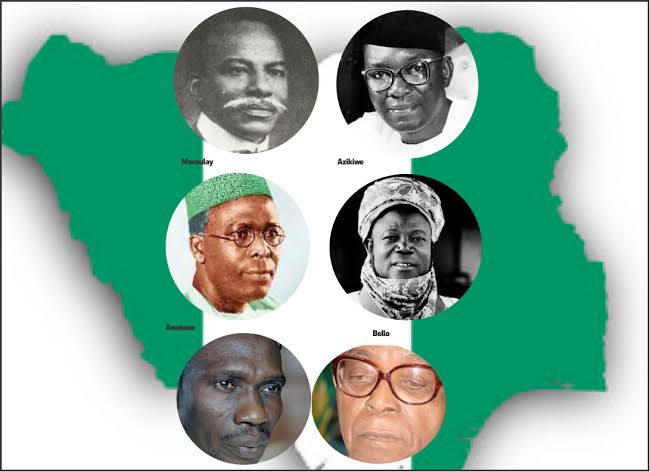
There is the need for deregulation, trade facilitation and investment in infrastructure in Nigeria. The heroes who fought for a free and self-reliant Nigeria did not envision a country perpetually reliant on foreign imports and decaying infrastructure. Investing in agriculture, manufacturing, tech and SMEs honours their legacy by building a more resilient and diverse economy.
Currency and Market Reforms
Reforms like the removal of fuel subsidies and floating the naira are steps toward economic realism, that is, reducing corruption-prone spending and allowing market forces to determine exchange rates. These measures, while painful in the short term, will correct longstanding distortions that have kept Nigeria from becoming globally competitive.
Human Capital Development
Improving education, healthcare and vocational training cannot be over emphasized. Nigeria’s economic challenges are not just about policies, they are also about people. The call for skill acquisition centres in every Local Government Area and removal of hiring restrictions that unfairly exclude youth is a commitment to inclusive growth. These actions strive to give every Nigerian a stake in the future, echoing the nationalist ideals of empowerment and social justice.
Cultural and Moral Renewal
As most spiritual leaders will say, there must be individual ‘revival’ before national change can happen. Spiritual and moral transformation, including a return to the fear of God, is a response to Nigeria’s moral decay. Corruption, violence and selfish governance are seen not just as institutional failures, but as ethical ones.
Anti-Corruption and Governance Reform
Recovered stolen public funds should be reinvested into the economy. Corruption, which undermines every aspect of national development must be combatted through stronger institutions, legal accountability and plugging revenue leakages.
Youth and Civic Engagement
There’s an urgent need for youth empowerment; not just through employment but through moral reorientation and civic responsibility. Political thuggery and social vices must be shunned, replacing them with discipline and national pride. This speaks to a fundamental question: are the youth inheriting a nation worth serving? These recommedations aim to make that answer “yes.”
Economic Nationalism
I strongly encourage supporting local industries, from buying Nigerian-made products to boosting exports and reducing imports. If Nigerians adopt this mindset, they would not only be fulfilling individual dreams but also stimulating the economy. State and local governments should be empowered to drive development in agriculture, SMEs, tourism and local industries by granting them more fiscal autonomy and access to development financing.
Strengthen Regulatory Institutions
Institutions like the EFCC, ICPC, CBN and SEC must be depoliticized and equipped to enforce laws against corruption, financial crimes and market abuse. Regulatory failure has allowed looting and economic sabotage to go unchecked for decades.
Prioritize Energy Sector Reform
Stabilizing the electricity supply is critical for job creation and industrial growth. Some areas that can be considered include:
Incentivizing off-grid solutions (solar, hydro).
Privatizing and restructuring inefficient government-owned energy assets.
Institutionalize Budget Transparency and Citizen Oversight
Make budget processes fully open, including real-time tracking of allocations and spending. Citizens should have access to dashboards showing how public funds are used.
Reform Land Use and Property Rights
Revise the Land Use Act of 1978 to allow more secure property ownership, especially for farmers and entrepreneurs. Clear land rights would unlock credit, investment and private sector development in underserved regions.
Establish a National Employment Guarantee Scheme
Adapted from global models (e.g., India’s MGNREGA), such a scheme could provide temporary jobs in public works (roads, sanitation, afforestation) to reduce unemployment and boost consumption while infrastructure is improved.
Build an Inclusive Digital Economy
Expand broadband internet access, especially in rural areas, and promote digital literacy to unlock opportunities in tech, online business, remote work and innovation. Nigeria’s youth need to be part of the global knowledge economy.
Institutionalize Diaspora Investment Channels
Encourage Nigerians abroad to invest directly into SMEs and infrastructure projects by creating transparent, secure diaspora bonds, investment clubs and tax incentives. Nigeria’s heroes dreamt of unity—this is a way to make it borderless
CONCLUSION
It is clear that our urgent task as a people is to achieve a credible leadership recruitment process, especially at the highest level. One might well wonder: what is wrong with the present one and how can we correct it? The answer is not new: it is the same answer that has been proffered over the years, but whose application has unfortunately, proved to be the Gordian Knot, a hard nut to crack.
We must evolve a new national ethos which prioritizes competence, merit and patriotism above primordial considerations such as ethnicity (place of origin), religion and social status. We must be Pan-Nigerian in our outlook – and in the choices of our political leaders – and discard and eschew sentiments. We must be objective and call a spade a spade – no matter whose ox is gored. We must be ready to call out a thief, a deviant, or someone whose source of wealth is either unknown or suspect. We must stop glorifying ill-gotten or suspect wealth by rewarding those who flaunt them with traditional titles or political offices. That was how it was in the olden days. We must return to those days – we must return to our traditional values and ethos where character, dignity and integrity were all that mattered.
More specifically, we must re-prioritize education as it holds the key to economic empowerment and prosperity. That was how the Asian Tigers achieved the famous leap from Third World status to First World economies. We must strengthen our institutions, particularly our electoral, economic, justice and law enforcement sectors.
Ours must become truly a nation of laws, instead of a nation of men – which it currently is. Justice must not just be an empty slogan, it must be done and seen to be observed in the choices, policies and programmes of Government at all levels. It must truly be blind, not just in the decisions of our courts, but beyond them – in the behaviours of ALL Government officials. They must, like Caesar’s wife, be seen to be above board. They must not be suspected of living above their means and they must NEVER flaunt wealth – either legitimately acquired or not. This is simply because THE OPTICS ARE ALL-IMPORTANT.
This re-orientation should apply across the board to include our armed forces, which must be re-trained to emphasise their professionalism. They must realize that theirs is a calling which is probably the highest of all: the readiness to put their lives on the line for their country and the rest of us. Equally important are other gate-keepers: the electoral institution (INEC), our law enforcement agents and the judiciary. Short of being angels or saints, they should either shape up or ship out. They simply cannot run with the hare and hunt with the hound; they cannot have it both ways.
Like the rest of our public officers, they should seek their work first and foremost as a service: they are there to serve the country and the public – not themselves. An honest public servant is seldom a rich public servant – unlike what currently obtains. Under the Constitution, a public servant is only permitted to engage in farming (or agriculture) and no other business. Unfortunately, this rule is currently more observed in the breach. This must change. Any public servant who is not satisfied with this or her salary and emoluments should have the courage and decency to leave honourably – otherwise he or she should face the consequences, if caught dipping his or her hand in the public till or otherwise violating the Code of Conduct enshrined in the Constitution.
In this, we can learn a thing or two from China, which even though is a one-party dictatorship, has such zero tolerance for official corruption (it attracts the death penalty) that such behavior is the exception rather than the rule as is the case here. An extraordinary situation certainly deserves extra-ordinary solutions. We should not shy away from taking difficult decisions. Hippocrates and Albert Einstein’s dicta are quite apposite here.
With the 2027 elections fast approaching, the messaging must be loud and clear: electoral malpractices and violence – by anyone, no matter how highly placed – should not be tolerated. Whatever tools the umpire – INEC – needs must be provided – and more. Whatever else needs to be done must be done. Scapegoats should be made of deviant public-officials. The electoral process must be sanctified, as that is the only guarantee of credible outcomes or results.
Technology must be fully embraced to strengthen the integrity of Nigeria’s democratic process. Elections should be viewed as peaceful competitions of ideas, not battles for power. Both winners and losers must prioritize national unity—showing maturity, humility, and respect for democratic outcomes. Above all, the will of the people must prevail: voters’ choices must count and determine the outcome.
The importance of credible polls cannot be over-emphasized. When leaders emerge from such a process, they can easily be held to account. That is the best way of ensuring a Government of the people, by the people and for the people (Abraham Lincoln, November 19, 1863); and thus, finally solving the problem of Nigeria, as graphically illustrated by late Prof. Chinua Achebe as aforesaid. Credible polls are the only key that will unlock and address all the challenges identified above. They might not be a magic bullet but there is no viable alternative in terms of leadership recruitment.
However, the urgent need for a new people’s driven constitution cannot be over emphasized. A Constitution that truly reflects the will, diversity and collective aspirations of all Nigerians. A Constitution that serves as a binding covenant, a holy matrimony of unity, equity and justice. This is the only way to lead Nigeria out of its present quagmire (and nightmare) into a brave new world of safety, security and prosperity.

1 Comment
https://shorturl.fm/6539m