

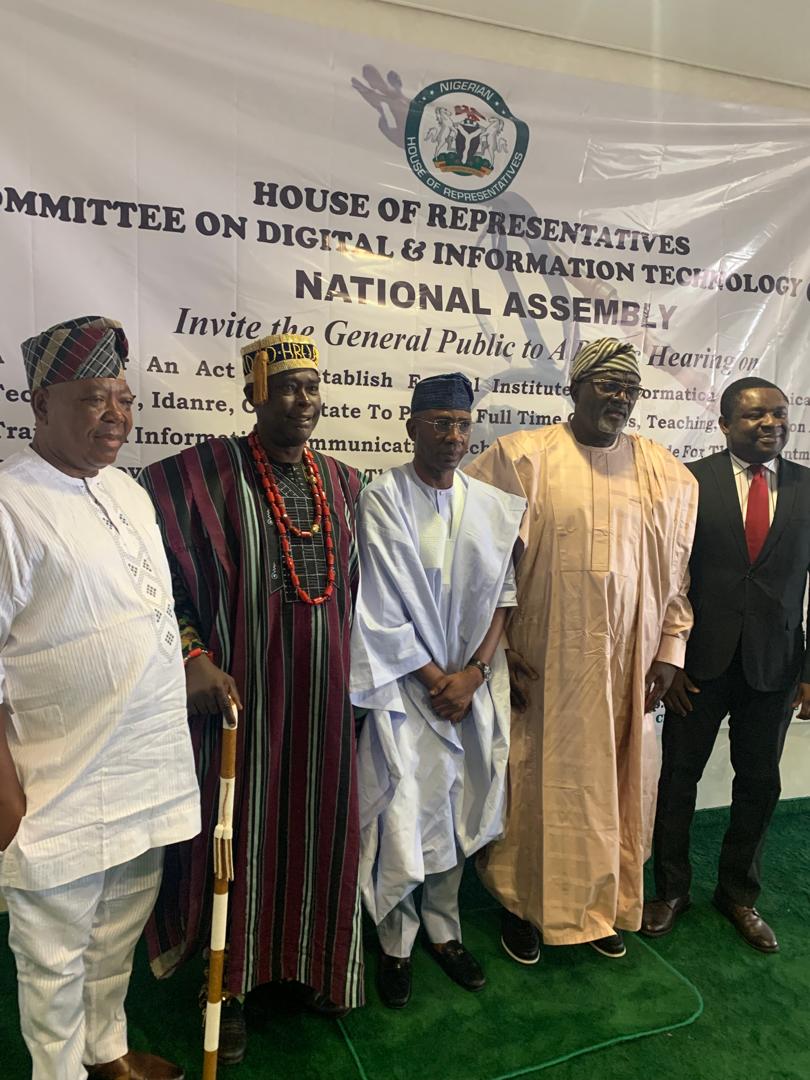

The National Assembly’s committee on Digital and Information Technology welcomed a delegation from Idanre early on May 27, 2024.
This delegation was prompted by a bill initiated by Hon. Festus Akingbaso, the representative for the Idanre/Ifedore Federal Constituency in the House of Representatives.

The delegation included Hon. Taye Sunday, representing the Idanre Development Assembly (IDA), and Olu Claudius Ademehintoye, a local monarch, who advocated for the approval of a Federal Institute of Information and Communication Technology in their community.
Hon. Akingbaso had formally appealed for the establishment of the Institute in the Local Government Area through a bill titled “Bill for an Act to Establish the Federal Institute of Information, Communication Technology, Idanre, Ondo State.”
The bill has successfully passed the first and second readings and is currently in the committee stage, where it is expected to be debated, vetted, and recommended for amendments by experts.
The committee chairman pledged to expedite the bill’s passage, emphasizing the importance of the delegation’s presence. He invited them to address the committee regarding the need for the Institute.
Olu Ademehintoye urged the committee to convey the challenges faced by his Local Government Area to the National Assembly, noting that it is the only community in the state lacking a federal higher institution.
Hon. Taye Sunday on his own highlighted Idanre’s significant economic contributions to the state and the nation, particularly in cocoa and timber production. He asserted that as the largest cocoa producer in the country, Idanre is overdue for a tertiary institution, which the community believes will enhance its local economy and provide access to quality ICT education.
An excerpt from a report prepared by the media aide to Hon. Akingbaso, Kelvin Babalola, states:
“It was a busy day for the House Committee on ICT, Hon. Festus O. Akingbaso, MHR, Idanre/Ifedore Federal Constituency, and the Idanre delegation as the public hearing on the establishment of the ICT Institute in Idanre was thoroughly examined. The bill, which has been read twice, was sent to the ICT Committee of the House of Representatives as part of the standard law-making process.”
“Representatives from the community included the Idanre Development Assembly, represented by former Council Boss Hon. Taye Sunday and traditional ruler Oba Olu Claudius Ademehintoye. They urged the committee to accept the bill to ensure a balanced distribution of federal institutions in Ondo State. Hon. Akingbaso detailed the benefits of the Institute and called for prompt action to facilitate its passage through the final reading.”
“The House Committee on ICT Chairman assured the community representatives that their requests would be addressed and praised the bill’s sponsor for his unwavering dedication to uplifting his constituency. After the hearing, Rep. Akingbaso expressed gratitude to those who represented his constituents and those who submitted position papers, promising to advocate for the bill’s passage by the end of the year.”
Viability of the Bill
The proposed ICT Institute in Idanre aligns with the federal government’s vision to establish more higher institutions to combat illiteracy in the country, especially in light of the rapid increase in private schools. It has the potential to be adopted in subsequent readings as an independent educational institute, possibly affiliated with a nearby university specializing in ICT.
According to Wikipedia, “An institute is an organizational body created for a certain purpose. They are often research organizations (research institutes) created to conduct research on specific topics, or they can also be professional bodies.”
“In some countries, institutes may be part of a university or other institutions of higher education, functioning as a group of departments or as an autonomous educational institution without traditional university status, such as a ‘university institute’ or institute of technology.”
For example, the National Film Institute as well as St. Albert Institute For Higher Education, Kaduna, are both affiliates of the University of Jos. In the same vein, Michael Imodu National Institute for Labour Studies, Ilorin, is also an affiliate of the University of Ilorin.
Furthermore, an affiliated school operates independently but has a formal collaborative agreement with a larger institution that may exert some influence over its academic policies, standards, or programs.
Rather than the establishment of a full ICT university to stop it, it could serve as an impetus for the success of the bill.
