

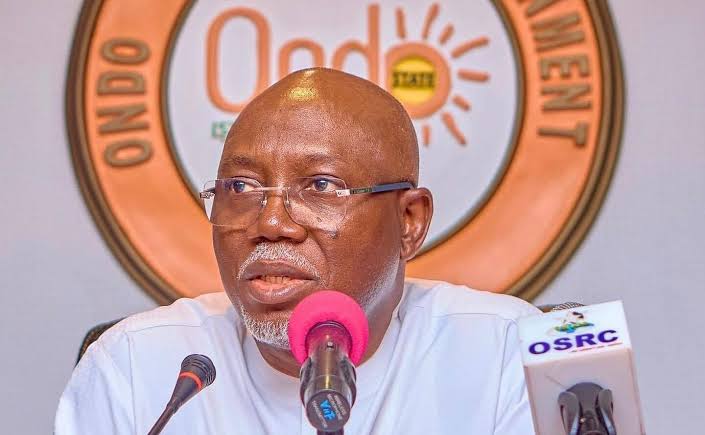

The Governor of Ondo State, His Excellency, Hon. Lucky Orimisan Aiyedatiwa was sworn-in for a new tenure on the 24th day of February 2025.
Few weeks before the commencement of this new tenure, Governor Lucky Aiyedatiwa dissolved the State Executive Council. Hopes were then high that Governor Aiyedatiwa would inject fresh competent hands into the governance structure of the State to fill in the governance void created by many months of shenanigans occasioned by the illness and demise of his predecessor. However, more than sixty days after his swearing-in, the status quo remains leaving a yawning gap in the constitutional requirement for lawful and inclusive governance.

In the aftermath of the inordinate delay by former President Muhammadu Buhari to constitute the Federal Executive Council in 2015 and in a bid to forestall a repeat of such an aberration which negatively impacted the country’s economy, the National Assembly amended the 1999 Constitution to insert a provision which mandates the President and Governors of States to nominate their Ministers and Commissioners within a specific period.
In view of the above, section 192 (6)(a) of the Constitution of the Federal Republic of Nigeria 1999 (as amended) mandatorily prescribes that _“the nomination of any person to the office of a commissioner for confirmation by the House of Assembly shall be done within sixty days after the date the Governor has taken the oath of office.”_
Commendably, in less than twenty-four hours after taking his oath of office on the 24th day of February 2025, Governor Aiyedatiwa announced the nomination of two commissioner-designates to wit: Dr. Olukayode Ajulo, SAN, OON and Mrs Omowunmi Isaac as Attorney-General and Commissioner for Finance respectively whose nominations were subsequently confirmed by the State House of Assembly. The proactiveness associated with the nomination of the two commissioners accorded with a standard which the situation of the State deserved, the State having been in governance limbo for long with the illness and subsequent death of the late Governor Akeredolu followed by months of shenanigans and politicking which ultimately ushered in Aiyedatiwa as Governor. Real and inclusive governance was what was expected to be set in motion.
Although Section 192 (1) of the 1999 Constitution grants to a State Governor the discretion to establish offices of commissioners, that discretion is not absolute as to the number of commissioners to be appointed by a Governor given that Section 192 (2) prescribes that the Governor in appointing commissioners must ensure that the appointments reflect the diversity in the State in conformity with Section 14 (4) of the same Constitution.
It then begs the question whether only two commissioners can validly constitute the State Executive Council in view of the provisions of Sections 192 (2) and 14 (4) of the Constitution which mandates the Governor to ensure that the appointment of commissioners must reflect the diversity of the State and give the people across board a sense of belonging.
In addition to the fact that the current constitution of the Ondo State Executive Council negates the constitutional requirement for inclusivity in Sections 192 (2) and 14 (4) of the Constitution, the current state of the council whereby certain critical sectors of the state including education, health, energy, land administration, women affairs, commerce, works, agriculture, youth and sports have been left without direction and representation at the State Executive Council leaves so much to be desired.
The point must be quickly made that the neglect/delay in the appointment of Commissioners cannot be remedied by the appointment of other political appointees such as special advisers and senior special assistants as these appointees lack any specific constitutional role in the adminstration of the affairs of the State. On the other hand, Section 193 (2) (a) (b) and (c) of the Constitution assign specific roles to commissioners to among others hold regular meetings with the Governor and his Deputy for the purpose of “detemining the general direction of the policies of the Government of the State.”
Consequently, it is respectfully submitted that the current Ondo State Executive Council as presently constituted exists in serious breach of the provisions of Sections 192 (2) (6) (a) and 14 (4) of the 1999 Constitution.
It is hoped that in no distant time, the Governor would take conscientious steps to remedy and rectify this fundamental constitutional defect by taking refuge under proviso to Section 192 (6) (a) to immediately nominate and present to the State House of Assembly the full compliments of commissioners cutting across at least the nine Federal Constituencies in the State.
Vincent Adodo, Esq., LL.M, FIMC, CMC.
Legal Practitioner
Saturday, 17th May 2025
