

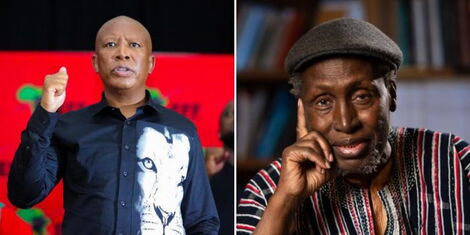

Controversial South African opposition leader and politician, CIC Julius Malema, has joined many others to pay a glowing tribute to veteran Kenyan author Ngũgĩ Wa Thiong’o, who gave up the ghost on Wednesday, saying he explored the power of his literary works to agitate for the expansion of the democratic space.
Malema, the Economic Freedom Fighters (EFF) party leader, stated that Prof Ngũgĩ represented and promoted what he termed as hard truth, through his literary work, which African leaders must adopt if the continent is to experience true liberation.

In a statement through the party, Malema highlighted Ngungi’s unwavering commitment to decolonisation, African identity, and radical economic transformation.
The statement said: “EFF joins the people of Kenya, the African continent, and the global literary community in mourning the passing of Ngũgĩ wa Thiong’o, a titan of African literature, and a fierce proponent of decolonization who devoted his life to imagining a truly liberated Africa.”
Malema, a firebrand leader known for his pan-Africanist and socialist ideals, shares the same views with the professor. Just like Ngũgĩ, Malema is also fighting for cultural sovereignty and Africa’s demand for economic freedom.
Both believe that true liberation goes beyond political independence and must address language, culture, and economic self-reliance.
When he started writing in 1970, Ngũgĩ renounced English as a medium of writing and instead, adopted Gikuyu as a symbolic act of resistance.
According to Malema, this was a powerful statement against the psychological weight of colonialism, an idea he suggests Africans should echo in their push for identity free from Western validation.
Due to his literary activism, Ngugi wa Thiong’o was imprisoned under President Moi’s regime. The arrest did not stop his determination, instead, he used the opportunity to write another book titled “Devil on the Cross” on toilet paper while in prison.
According to Malema, this proves that ideas cannot be silenced by bars or brutality, a message that he argues should resonate with movements pushing for radical change.
While referring to Ngugi’s books, including “Decolonising the Mind”, “Ngaahika Ndeenda”, “Wizard of the Crow”, Dreams in a Time of War” , “Birth of a Dream Weaver”, and others, said that they are important texts needed for African liberation.
As Africa continues to mourn Ngũgĩ, Malema urged leaders and young revolutionaries to study his works, arguing that his ideas must live on through political action and economic transformation.
Ngũgĩ wa Thiong’o passed away on May 28, at the age of 87.
