


 INTRODUCTION
The theme of this writing couldn’t be more apt given the cocktail of challenges which continue to bedevil our dear country almost 65 years after political independence from Britain. The list is so familiar that it has almost become as fixed and constant as the Northern Star. The usual factors are implicated: insecurity (especially the physical kind, the most serious of all), high cost of living, unemployment, corruption, crumbling infrastructure, non-functional education and widespread disenchantment with the Nigeria project, leading to mass migration (so-called ‘japa’) of our best and brightest for the proverbial greener pastures.

DEFINITION OF TERMS
In short, virtually everything about this writing concerns those things the subject of this tribute fought for (and sadly, died for) without fully achieving. This is by no means an exaggeration as this excursion or trip down memory lane will shortly reveal. Before doing that, however, let me give a few preliminaries which the title of this paper evokes: what is a “quest” and what do the ideas of ‘unity’, ‘equity’ and ‘justice’ signify and connote? It is only by satisfactorily deciphering them and examining their status in Nigeria, that we can rationally pose the question of whether or not our heroes past (including Pa Edwin Clark) labored in vain.
QUEST is a noun. It means “the act or an instance of looking for or seeking; search”. It also means “the object of a search; goal or target. The word ‘unity’ is also a noun. It means “the state of being one; oneness, a whole or totality; the state or fact of being united or combined into one, as of the parts of a whole; unification; agreement or concord”. ‘Equity’ (another noun) refers to “fairness or justice in the way people are treated”; it signifies freedom from disparities in the way people of different races, genders, etc, are treated. ‘Justice’ is the quality of being just, impartial or fair: the principle or ideal of just dealing or right action. In its broadest sense, is the idea that individuals should be treated fairly. ‘True Federalism’ is “A system of governance where the component units (states or regions) have significant autonomy and control over resources, security, and development, as opposed to over-centralization by the federal government”.
ABSENCE OF UNITY, EQUITY AND JUSTICE IN NIGERIA
If there is one thing on which there is a broad consensus (near-unanimity, in fact) in Nigeria, it is the virtual absence of unity, equity and justice. Yes, we have a multitude of institutions, structures, codes and legal frameworks all of which were established and designed to achieve and sustain those ideals – from the Constitution, the courts, Federal Character Commission, Police, INEC, Legislature, Executive, etc and similar institutions. Yet, the malaises of disunity, injustice and inequality persist. This is despite the efforts our heroes past-including the object of this gathering.
MANY QUESTIONS
Accordingly, the question is: why have these ills stubbornly defied every effort at curbing (if not totally eliminating) them? Is the Nigeria Project inherently flawed – or even doomed? Is the problem in the faulty foundation? Did our founding fathers get it right? Were they mistaken, genuine visionaries or hopeless romantics whose quest for nationhood (cobbling together a single country from what was, in reality, an amalgam of diverse, disparate, nations) misplaced? Did they really have a say in the matter given that the idea of Nigeria was conceived by our colonial masters (the British) who proceeded to impose it upon us willy nilly through Lord Lugard’s almagamation of the Northern and Southern Protectorates and the Lagos Colony on the 14th of January, 1914 with Miss Flora Louisa Shaw giving her the name “Nigeria” in an article she wrote in The Times of 8th January, 1897? Is it because the Royal Niger Company sold its holdings to the British for £865,000 (Eight Hundred and Sixty Five Thousand Pounds) in 1899 which marked British acquisition of the territory called Nigeria?
This poser is as relevant as ever because, over a hundred years since that forced marriage (the amalgamation of 1914), we are still groping in the dark and, more than anything, else, our security challenges (specifically incidents of random, seemingly senseless killings targeting ethnic groups-especially in Benue, Plateau and now Edo States) expose our fault-lines in their stark reality. In this regard, some historical perspective would be helpful to navigate the labyrinths of this poser.
PRE-INDEPENDENCE
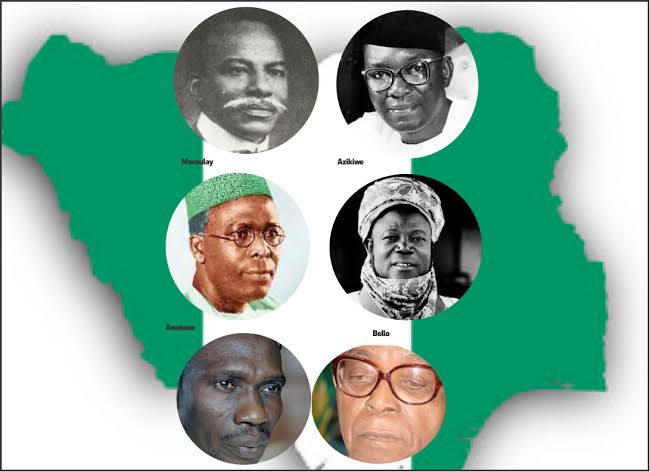
I owe a lot of this part of my speech to Oladayo Ogunbowale, who opined that early in the 19th Century, anti-colonialist elements began to mobilise to resist the colonial rule of Britain. At the fore-front of the struggle for self-rule in Nigeria were progressives like Sir Herbert Macaulay who established the Nigeria National Democratic Party (NNDP) in 1922, Pa Michael Imoudu who led the labour movement revolt against the colonialist autocratic and inhuman practices; Chief Obafemi Awolowo who was one of the brains behind the establishment of the Action Group (AG) and later Unity Party of Nigeria (UPN), Awo also established the Nigerian Tribune in November 1949; late Dr. Nnamdi Azikwe who established the National Council of Nigeria and Cameroon which later metamorphosed into National Council of Nigerian Citizens (NCNC) as well as Nigeria Peoples Party (NPP) in the 70s. Zik was also the brain behind the establishment of the West African Pilot newspaper. From the Northern Nigeria, we had people like Alhaji Tafawa Balewa and Sir Ahmadu Bello who were the arrowheads of Northern People’s Congress (NPC). What all the aforementioned people had in common was that they form part of Nigeria’s depleting genre of heroes. Are their labours in vain?
THE 1914 FORCED MARRIAGE
The problem, in the words of Ogunbowale sprang from the forced marriage of the Northern and Southern protectorates in 1914 that resulted in a country called NIGERIA. This marriage lacked mutual consent, unity, love, cohesion and most other good ingredients that would ensure a loving and peaceful marriage. This was unlike America’s deliberate effort at building a strong union through a voluntary Convention in Philadelphia, Pennsylvania between May 14 and September 17, 1787, which 39 out of 50 states signed the Constitution agreeing to certain Articles of Faith. Even the country’s patriarch and founding leaders at that time attested to this fact.
Lord Lugard: “The North and the South are like oil and water, they will never mix”.
Alhaji Sir Abubakar Tafawa Balewa: “The Southern people who are swamping into this region daily in such large numbers are really intruders; we don’t want them and they are not welcome here in the North. Since 1914, the British Government has been trying to make Nigeria into one country. But the people are different in every way, including religion, custom, language and aspirations, we in the North take it that Nigeria unity is only a British intention for the country they created”.
Chief Jeremiah Obafemi Awolowo: “Nigeria is only a geographical expression to which life was given by the diabolical amalgamation of 1914, that amalgamation will EVER remain the most painful injury a British Government inflicted on Southern Nigeria.”
Dr. Nnamdi Azikiwe: “If this embryo republic of ours must disintegrate, then in the name of God, let the operation be a short and painless one.”
Dr. Nnamdi Azikiwe to Alhaji Ahmadu Bello: “Let us forget our differences”.
Alhaji Ahmadu Bello to Dr. Nnamdi Azikiwe: “No, let us understand our differences. I am a muslim, a Fulani and a Northerner; you are a Christian; an Igbo and an Eastener. By understanding our differences, we can build unity in our country.”
Rtd. General Yakubu Gowon: “Suffice it to say that putting all considerations to the test, political, economic as well as social, the basis of unity is not there.”
Odumegwu Ojukwu: “for unity to be meaningful, it has to be creative, not the unity of Jonah in the whale, but the unity of the Holy Matrimony. The first can only lead to defecation, the second to procreation.
THE PROBLEM WITH NIGERIA
All I have said above, show but one thing: that the Nigeria Project suffers from what was famously captured by the late Professor Chinua Achebe as simply and squarely that of leadership (though I would add followership). First enunciated in the mid-eighties, it remains true today. That challenge has been at the root of every other malaise that has bedeviled the country since independence, particularly religious, ethnic, corruption and worsening security in all their ramifications. To say that life in Nigeria is – in the often-quoted words of Thomas Hobbes – nasty, solitary, brutish and short, would be an understatement. Simply put, no one and nowhere is safe in Nigeria.
An explosive cocktail of factors and Non-State Actors have since conspired to hold the country hostage and prevent it from fulfilling it’s potential as the greatest black nation on earth. It is clear, therefore, that diagnosing the challenge is the easy part. To a certain extent, so is the cure: get the leadership right and every other thing will fall into place. As usual, however, the devil is in the detail.
MULTI-FACETED CHALLENGES
The labours of our heroes past appear to be in recession due to the cocktail of challenges bedeviling the country.
THE CHALLENGE OF INSECURITY
Seldom in our recent history has insecurity become the focus of everyone – from policy makers to the man on the street. This was prompted by recent repeated advisories, first by the United States, and subsequently by some European countries for their citizens to leave Abuja, the nation’s capital. I have repeated quoted Martin Niemoller, a Lutheran Pastor in Germany, who spent the last eight years of Nazi rule (1937 – 1945) in Nazi Prisons and Concentration Camps. He said, “First they came for the socialists, and I did not speak out—because I was not a socialist. Then they came for the trade unionists, and I did not speak out—because I was not a trade unionist. Then they came for the Jews, and I did not speak out—because I was not a Jew. Then they came for me—and there was no one left to speak for me.”
The situation has, naturally, focused attention, on the state of the polity: Is Nigeria on the brink? What exactly is the nature of the security challenge that we face? Does it defy solution?
SCOPE OF INSECURITY IN NIGERIA
The challenge of insecurity in Nigeria is multi-dimensional. It has numerous forms, shades and characteristics. Some of its obvious manifestations, generally speaking, include political insecurity, health insecurity, economic/financial insecurity, food insecurity, education insecurity and social insecurity. Suffice it to say that insecurity is the reverse of security. In other words, insecurity – of any kind – is the absence of security.
Accordingly, the question, as previously posed, is: to what extent do these ills afflict or plague us as a nation and/or as a people? Are they existential? Have they always been part of our lived experience (our history) or have they worsened/ deteriorated over time? Have they assumed or morphed into worse (and, indeed, intractable) versions? The best way to tackle the riddle, in my view, is to break it down into its compound parts or facets – starting with political insecurity.
POLITICAL INSECURITY
Control of political power – especially at the centre – has always been keenly contested in Nigeria. This historical fact has, unfortunately, degenerated to the level of violence resulting in loss of lives and property.
A ONE PARTY STATE?
This ‘verbal’ or ‘spoken’ form of political violence can, if unchecked, quickly degenerate into the more invidious and physical kind, which is more commonly understood as political violence. Accordingly, it is safe to say that this sort of violence is the one that portends the greatest danger for the country going forward – in the near-to-medium, if not long term. This has been worsened by the spate of political defections across party lines but mostly in the direction of the APC ruling party, lending credence to serious fears of Nigeria becoming a one party state. It is therefore important to warn Nigeria against a one-party state as it self-implodes.
DISADVANTAGES OF A ONE-PARTY STATE
It encourages bad rule and poor governance;
It leads to the victimization of opposition groups and critical dissenting views; It perpetuates bad leadership in office; It can lead to the unpopularity of a regime, but which persists because it is not removeable; It can lead to dictatorship as dissenting views are suppressed; It is undemocratic as it has limited representation where minority views may not be represented or allowed participation; Lack of accountability and transparency in governance, Media censorship and propaganda; leads to human rights abuses and suppression of individual freedoms, Limited economic competition.
INSURGENCIES
Political insecurity is not the only one. Allied to it is a deadly cocktail of a nascent insurgence by the Boko Haram (lately ISWAP); the campaign for self-determination by IPOB (the Independent People of Biafra); that of Oodua Peoples’ Congress; random seemingly politically-motivated gun violence, resulting in attempted or actual murders; and incessant kidnappings for ransom. It must be said, however, that the phenomenon of kidnapping appears to be motivated more by economic factors than anything else, and that is conveniently our next focus. The attempt to tackle such incidents have prompted seemingly disproportionate and discriminatory deployment of security agencies across the country particularly in the South-East, as is evident from the suffocating check-points in the following location:
Security Checkpoints Along Onitsha To Enugu Expressway as an example of a siege.
A journey of a mere 86 kilometres from Onitsha to Enugu takes hours due to the incredibly suffocating numerous checkpoints along the highway as written by a concerned road user. He gave details as follows:
1. Army Gate Onitsha
2. Nkwelle Junction
3. Awkuzu Junction Army
4. Awkuzu Junction FRSC
5. Dunukofia LG hqts Police
6. Enugwu-Ukwu Junction Police
7. Amawbia Junction Police
8. Unizik Junction Army
9. Mopol base Awka Junction Police
10. Prince and Princess hostel front army
11. Amansea boundary Police
12. Ugwuoba boundary Police
13. Ugwuoba bridge police team
14. Ugwuoba Junction Army
15. Ugwuoba Junction NDLEA
16. Ugwuoba Junction FRSC
17. Ugwuoba Central Army
18. Oji River Junction Army 1
19. Oji River Junction Army 2
20. Ezeagu express Army
21. Near Nkwo ezeagu Police
22. Near tiles factory Police
23. Umumba Ndiuno express Police 1
24. Umumba Ndiuno express Police 2
25. 9th Mile Checkpoint
26. Nude express (approach to ninth mile) Police
27. Ngwo express Army
28. Ngwo express anti terror squad
29. Onyeama Hill (near refuse dump) Army
30 Onyeama Hill (near coal mine) Army
31. Abakpa Interchange Police
32. Abakpa Junction FRSC.
ECONOMIC INSECURITY
The worsening poverty in the country is so alarming that, not only are we reportedly officially in a recession, Nigeria with nearly 40 million people on the verge of extreme hunger has now been classified as the poverty capital of the world, replacing India and some other very poor countries with that dubious distinction. This malaise feeds the political insecurity addressed above, as the lack of opportunity for economic empowerment breeds a ready army of restless youths who are easily recruited by the political elite and used as little more than cannon fodders in fighting their political turf ‘wars’ or settling political scores.
It is, however, worse than that, as it informs the phenomenon of vote-buying, where prospective voters sell their franchise for a better future for as little as N10, 000 (US$12.00). The consequences are thus not hard to imagine: people assume political office (acquire political power) on the basis of a flawed illegitimate process (by compromising the electorate) as opposed to a fair contest based on programmes or ideology. Unfortunately, given that the practice is not new, it is simply a repetition of a seemingly endless cycle which does not look like breaking anytime soon – certainly not in the run-up to the next elections in 2027, in respect of which campaigns have clearly commenced in earnest. What with the on-going horse-trading and jockeying for power (manifested in the gale of defections which I earlier alluded to). I have already discussed this malaise under my OZEKPEDIA neologism – Electionocracy, Selectocracy, Judocracy, Executocracy and Legislatocracy. Perhaps, the Joseph Stalin – Live Chicken anecdote best illustrates this (to be continued).
